
Worth knowingThe wall walk has low beams and narrow wooden steps in places; mind your head, and keep wet-weather shoes in mind, since the boards and stone stairs can get slick.
A town still inside its walls
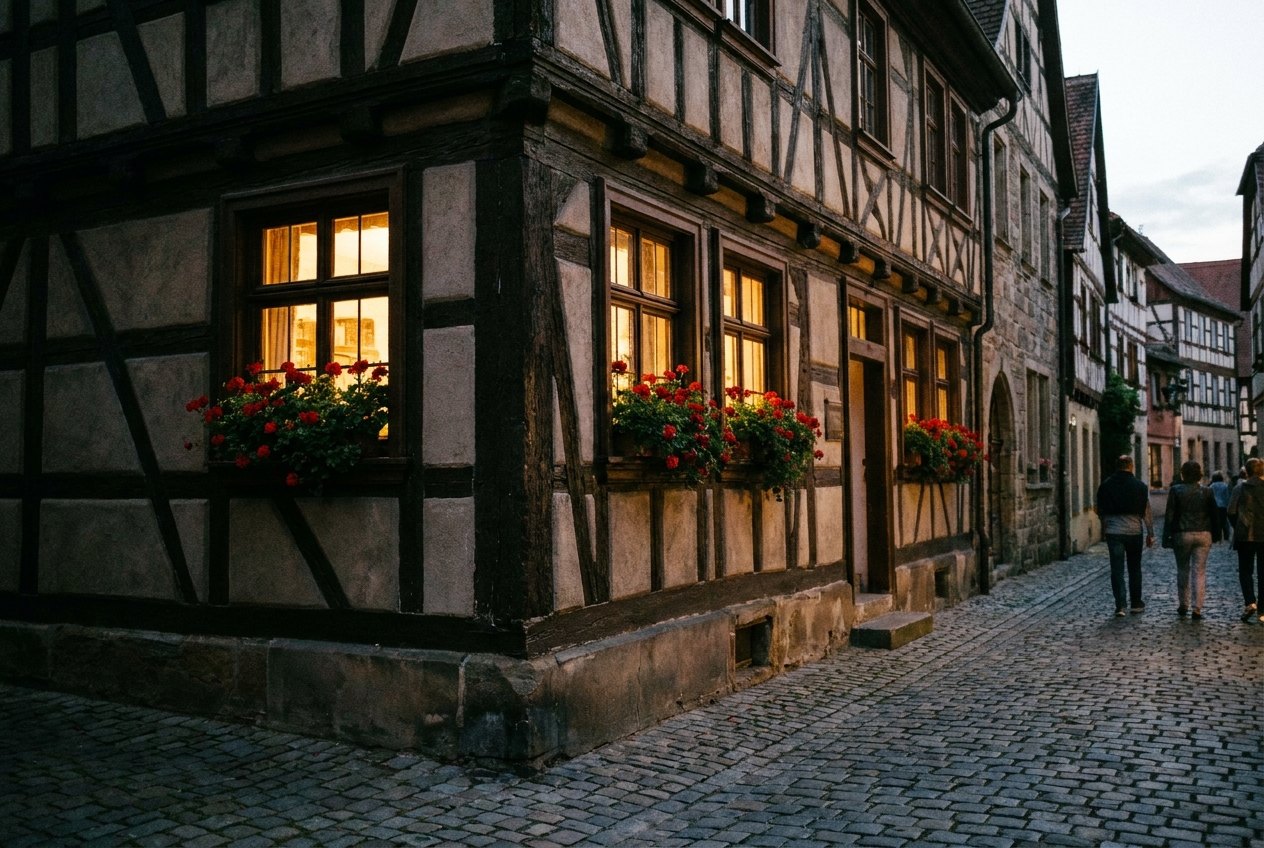
Rothenburg ob der Tauber sits on a spur above the valley of the little Tauber river in Franconia, northern Bavaria. Its medieval walls and towers survive around most of the old town, and inside them the streets are lined with timber-framed and stuccoed houses under steep tiled roofs. It was once a prosperous free imperial city. Later centuries passed it by, which helped keep its old shape.
The town was damaged in the final weeks of the Second World War, when part of the eastern side burned, and much of what you see there was carefully rebuilt afterwards. Today it is one of the most visited small towns in Germany, a stop on the Romantic Road, and it can feel busy in the middle of the day. The best way to meet it is from above, on the wall, and then again in the evening.
Up on the covered wall walk
A long stretch of the town wall carries a covered walkway along its top, roofed with tiles and open on the town side. You climb up by one of the stairways near the gates and towers and walk as far as you like. A good stretch runs along the eastern side of town, from around the Spitalbastei in the south up past the Röderturm and towards the Klingentor. The walkway is narrow, with low beams and timber posts, and it rises and falls with uneven steps.
What makes it special is the view inward. From up here you see what the streets hide: back gardens with vegetables and washing lines, sheds, courtyards, the tops of trees and a sea of red roofs with church spires poking through. Outside the wall, you look across fields and the edge of the newer town.
Look along the walls of the walkway, too. Many stones and plaques carry names of people and groups from many countries who gave money towards rebuilding the wall after the war. They are a quiet reminder that someone had to put this back together.
The Markt, the Plönlein and the streets between
Climb down and walk into the centre. The Marktplatz is the heart of town, framed by the Rathaus, the town hall, with its older Gothic part and a Renaissance front. The Rathaus tower can be climbed for a view over the rooftops, by steep stairs and ladders near the top.
From the Markt, a short walk south along Obere Schmiedgasse brings you to the Plönlein, the little sloping square where the street forks. A yellow timber-framed house sits in the fork, with the Siebersturm tower on one side and the lower road dropping towards the Kobolzeller Tor on the other. It is one of the most photographed corners in Germany, and it is far nicer early or late, when you are not waiting your turn for the view.
A few other places reward a slow look. St. Jakob, the main church, holds a famous carved altarpiece by Tilman Riemenschneider. The Medieval Crime Museum explains old law and punishment through a large collection. And the Burggarten, a garden on the site of the old castle at the western edge of town, is the best place to see the town's shape at once.
 Pairs well withHallstatt early in the morning and late in the day
Down into the Tauber valley
From the Burggarten, the land drops steeply into the Tauber valley. Paths lead down from the old town through gates and gardens to the river, where a quiet road and footpaths follow the water past meadows, mills and a small double-arched bridge. Walk a loop down one side and back up another, and you see the town from below, its walls and towers lined up along the ridge.
It is a different kind of Rothenburg, rural and calm. Very few day visitors make it down here, which is reason enough to go. Allow a couple of hours, wear shoes with grip for the steep paths, and remember that the climb back up is steeper than it looked on the way down.
After the coaches leave
Much of Rothenburg's daytime crowd arrives by coach and stays only a few hours. By early evening many of those visitors have gone, the souvenir shops close, and the town turns quiet. This is the time to wander. The lamps come on, footsteps echo on the cobbles, and the Plönlein and the Markt are almost empty. Staying the night, even one, is what turns a day of sightseeing into a real visit.
Getting here by public transport is simple, if a little slow. Rothenburg has its own station on a short branch line from Steinach, where you change from trains on the main line. Arriving by rail is part of the pleasure of travelling Europe by train, and the station is a walk of a few minutes from the walls. The cobbles are uneven, so a bag you can carry is easier than wheels, a point made in one bag for two weeks.
Christmas market season
From late November until shortly before Christmas, the Markt and nearby streets fill with the stalls of the town's Christmas market, the Reiterlesmarkt. Wooden huts sell decorations, sausages and mulled wine, and the timber-framed houses look their best with snow on the roofs and lights in the windows. You will also find the Schneeball, a local pastry of strips of fried dough shaped into a ball, sold all year but especially popular in winter.
The market is busy, especially at weekends, and rooms fill early. Weekday visits and early evenings are calmer. In winter, the wall walk is cold and can be slippery, so dress warmly. For a wider view of how the seasons change a trip, read why spring and autumn suit Europe best.
Filed under towns worth slowing for.