
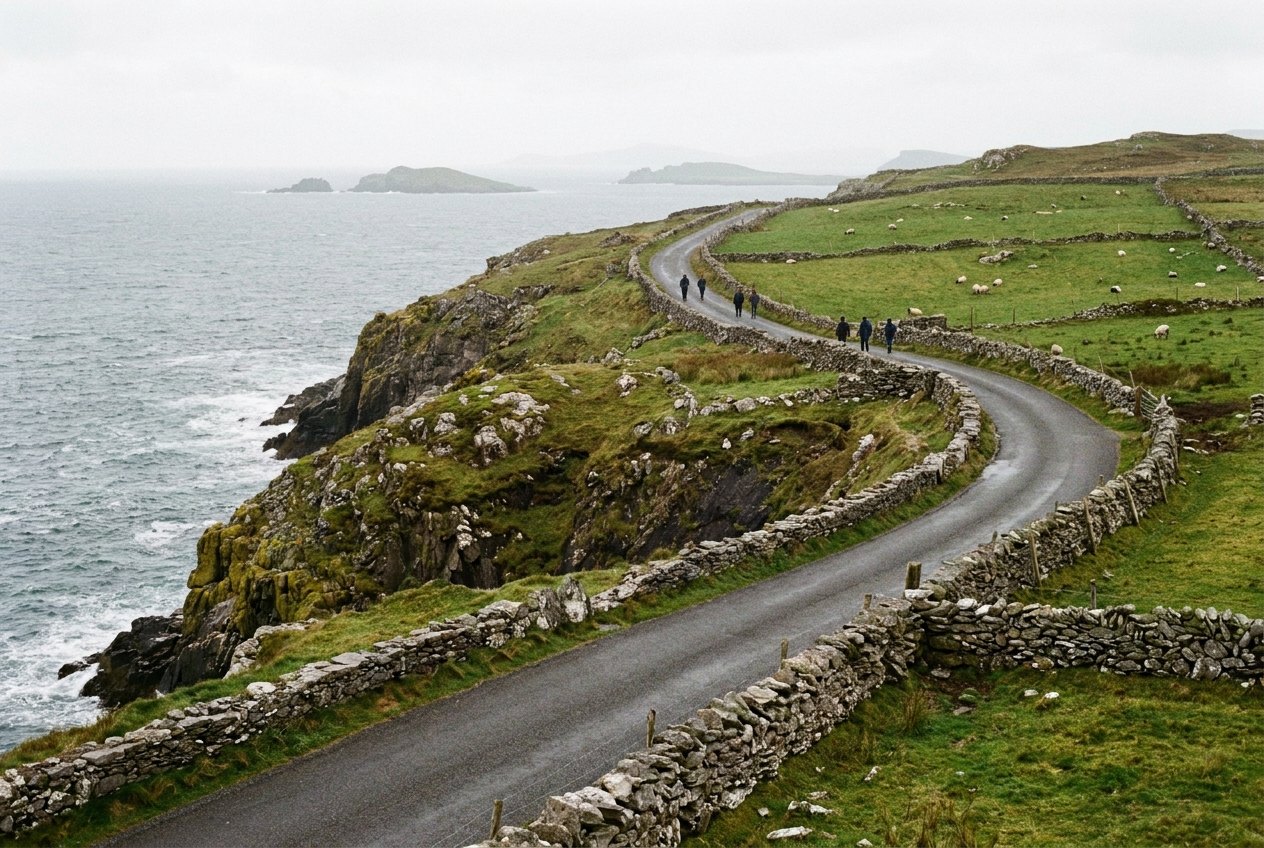
Worth knowingDrive the Slea Head loop clockwise. Most tour coaches go that way too, so you follow them instead of meeting them on the single-lane bends above the sea.
Dingle town as a base
Dingle sits on the southern shore of the northernmost of Kerry's big peninsulas, a working fishing harbour with a few streets of painted shopfronts climbing the slope behind it. It is small enough to cross on foot in ten minutes and lively enough in the evening that you will not want to sleep anywhere else. Much of the peninsula is Gaeltacht, an area where Irish is a community language, so road signs often give only the Irish form of a place name. Dingle itself appears as An Daingean, Dunquin as Dún Chaoin and Ventry as Ceann Trá.
Give the town at least two nights. One day goes on the loop around the western tip, the other on whatever the sky allows: a stroll along the harbour, a drive over the Conor Pass, one of the highest roads in Ireland, or simply a slow breakfast with the rain on the window. The peninsula rewards people who leave room in the plan, because a bright afternoon can follow a grey morning with very little warning.
Around Slea Head, clockwise
The Slea Head Drive leaves Dingle heading west through Ventry, runs along the cliffs around Slea Head itself, turns north past Dunquin and comes back across the middle of the peninsula. Without stops it is a short morning's drive; with them it fills a day comfortably. Go clockwise. The tour coaches do, and the narrowest stretches, where the road is cut into the hillside above the water, are far easier when the traffic flows the same way you do.
Small pull-ins mark the viewpoints. Use them rather than stopping on a bend, and pull in fully, because farm vehicles and cyclists share the road and the driver coming the other way may be as unsure of the edge as you are. Ventry's long, curving strand makes a good early stop to stretch your legs. Around the headland, the little beach at Coumeenoole is sheltered by cliffs and lovely to look at, but the currents along this coast can be strong, so treat it as a place for paddling and watching rather than swimming.
Stone huts and an early chapel
West of Ventry, on the slopes above the road near Fahan, clusters of beehive huts stand inside old stone enclosures. These corbelled buildings, called clocháns, were raised without mortar, each ring of stone stepping slightly inward until the roof closes over. Their age is hard to pin down and some have been rebuilt over the years, so treat any precise date you hear with caution. Several sit on farmland, and landowners may ask visitors to pay at the gate.
Gallarus Oratory, on the return leg, is the stone building most people carry home in their memory. It looks like an upturned boat, built entirely of fitted dry stone, with a single low door at one end and a small window at the other. Its date has been argued over for a long time; it is usually described as early medieval, and it still largely keeps the rain out. A short path leads to it from the road. Nearby, the ruined church at Kilmalkedar has an ogham stone in its graveyard, carved with the notched early Irish alphabet along its edge.
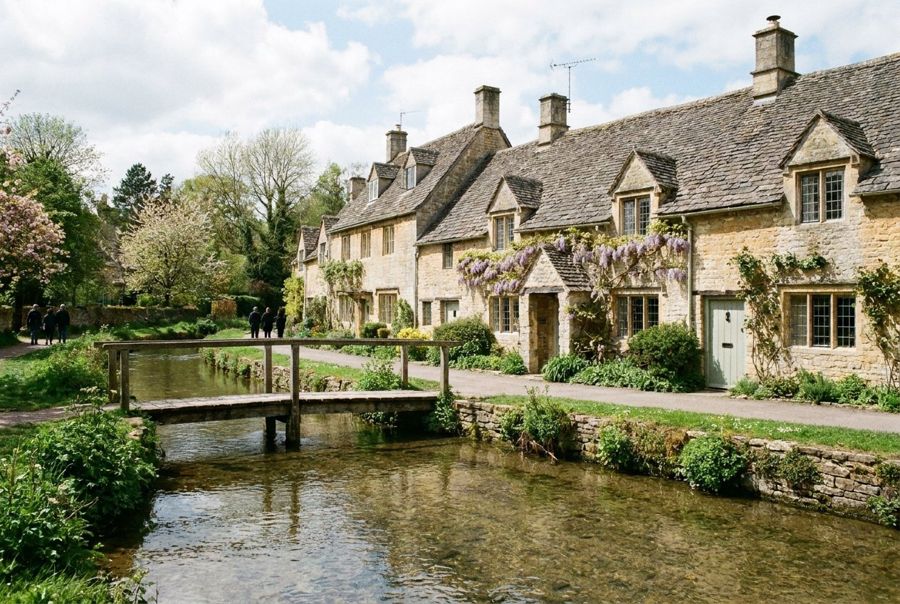 Pairs well withThe Cotswolds by train, bus and footpath
The Blaskets from the cliff road
From Slea Head and the road north to Dunquin, the Blasket Islands lie scattered across the sea, with the Great Blasket the long ridge closest to shore. People lived there until the middle of the twentieth century, when the last islanders moved to the mainland. The island community left an unusually rich body of writing in Irish about its daily life, and the Blasket Centre in Dunquin tells that story with care. It is worth an hour, particularly on a wet day.
In settled summer weather, boats cross to the Great Blasket, some of them from the small pier below Dunquin, reached by a steep zigzag path. Crossings depend entirely on the sea, so think of the trip as a possibility rather than a plan. Even from the clifftop, though, the islands change with every shift of light, and the view across to them is the reason the loop is famous.
Narrow roads and driving on the left
Ireland drives on the left, and this peninsula is not the gentlest place to learn. Rent the smallest car you are comfortable in, ask for an automatic if you rarely drive a manual, and get used to the car on the wider roads before you reach the cliff stretches. Where the road narrows to a single lane, the driver nearer a pull-in usually waits. A finger lifted from the steering wheel is the local thank-you, and you will soon find yourself returning it.
Without a car, you can still reach Dingle by bus from Tralee, which has a railway station; the same station habits described in Europe by train without the stress work just as well here. Small local tours and bike hire in town cover the loop. Cycling it is popular, though the climbs and the headwinds mean you should be honest about your fitness. Walkers can follow parts of the Dingle Way, a long-distance trail that circles the peninsula, and pick up the loop's sights on foot.
Weather that changes by the hour
Atlantic weather crosses the peninsula fast. Rain, sun and a rainbow can arrive in the same half hour, and the wind on Slea Head can make a car door hard to open. Pack a proper waterproof and a warm layer even in summer, keep the plan loose, and if the west end is lost in cloud, drive the loop tomorrow instead. May, June and September often bring the best balance of long light and lighter traffic, for the reasons set out in why spring and autumn suit Europe best. A single carry-on is plenty here too, and the case for it is made in one bag for two weeks.
Evenings in Dingle are the reward for a day of wind. Traditional music sessions are common in town, fish from the harbour turns up on many menus, and the walk along the quay as the light fades over the water costs nothing at all.
Filed under towns worth slowing for.