
Worth knowingLook at a mountain webcam before buying a ticket to go up high. If the summits are buried in cloud, spend the day on the valley floor and try tomorrow.
A valley cut deep
Lauterbrunnen lies in a glacier-carved valley in the Bernese Oberland, its floor flat and green and its sides rising as near-vertical rock walls hundreds of metres high. Streams pour over the rim at intervals along both sides, so many that the valley is known above all for its waterfalls; in early summer, when the snow is melting, you can count them from the road. The village itself is little more than one main street with the station at its lower end, and that simplicity makes it a practical base. Everything above it is reached by rail or cable car from here, and you can be back in your room within minutes of the last ride down.
Choosing where to sleep shapes the trip. The valley floor is convenient for trains and has the widest choice of rooms. Wengen and Mürren are quieter, higher and closer to the views, but every arrival and departure involves one more connection with your bags, and the last ride up in the evening is worth checking before you linger over dinner below.
Trains come up from Interlaken Ost on a short, scenic ride along the river. On the way the train divides, with one part continuing to Grindelwald; the carriage signs show which section is bound for Lauterbrunnen. The last stretch climbs into the valley, the walls close in, and Staubbach Falls appears ahead before you even reach the platform.
Staubbach and the falls inside the mountain
Staubbach Falls drops off the cliff just beyond the village, a single plume of water close to three hundred metres high that turns to drifting spray long before it reaches the ground; its name refers to that dust-like spray. A path climbs from near the village church to a gallery cut into the rock behind the fall, open in the warmer months, where you stand in the mist and look out through the water at the valley.
Further up the valley, Trümmelbach Falls is a different experience altogether. Meltwater from the glaciers of the high peaks thunders through a series of corkscrew chutes inside the mountain, reached by a tunnel lift and a set of lit walkways and stairs. It opens only in the warmer part of the year, it is loud and wet, and it is at its most powerful in early summer. Bring a layer even on a hot day; the air in the gorge is cool and damp.
Up to Wengen by cogwheel
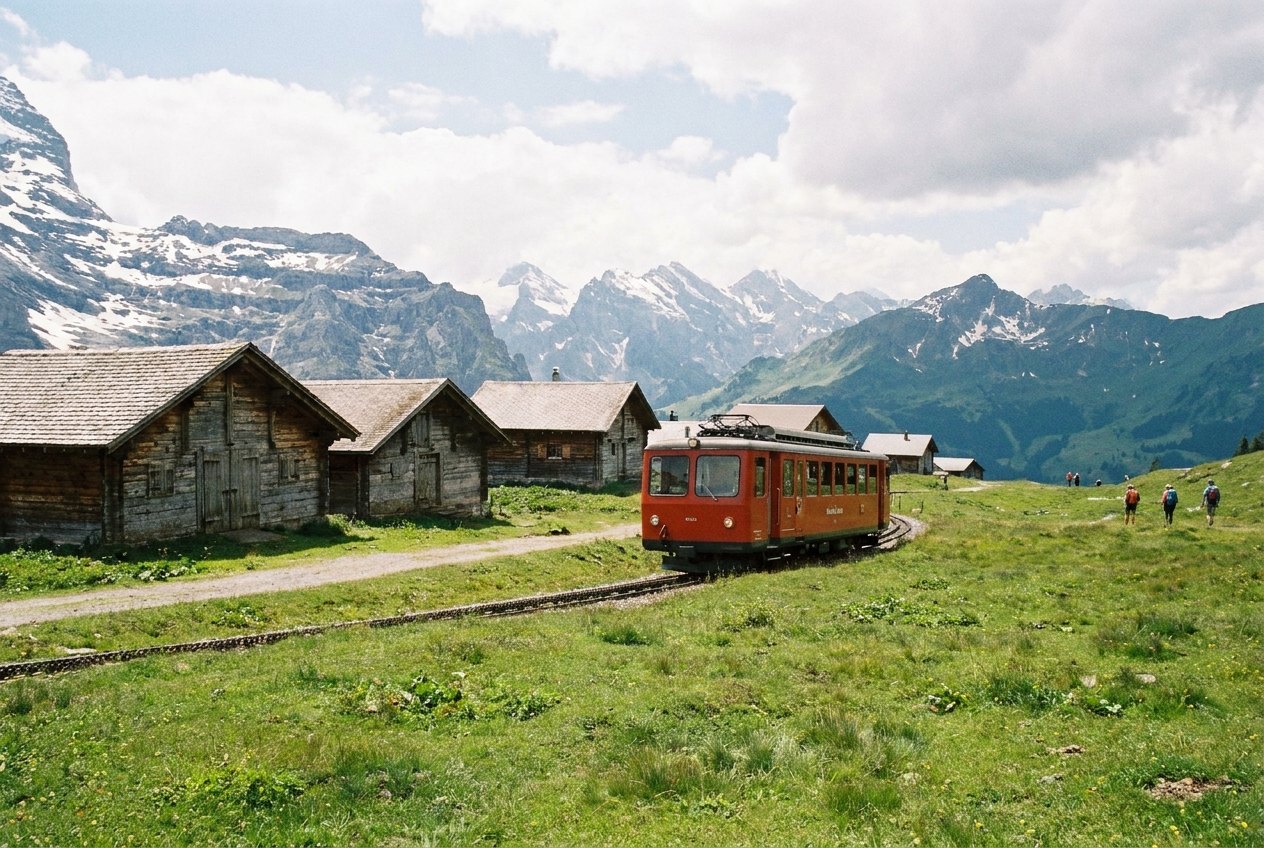
Across the valley from Staubbach, the Wengernalpbahn climbs out of Lauterbrunnen on a cogwheel railway, grinding steadily up through forest and meadow to Wengen. The village has no road for private cars, so arrival is by train and the main street belongs to walkers, electric carts and, in winter, skiers. The line carries on up to Kleine Scheidegg, the pass below the north face of the Eiger, where the Jungfrau Railway begins its climb through the mountain toward the Jungfraujoch.
Wengen sits on a sunny terrace with a long view up the valley toward the Jungfrau, and its footpaths fan out through pasture in every direction. An easy circuit on the gentle paths around the village, with a bench at every turn, is enough for an afternoon. Stronger walkers can ride to one of the stations higher up and walk down, which is easier on the lungs than climbing and gives the views in front of you all the way.
 Pairs well withHallstatt early in the morning and late in the day
Mürren on its ledge
On the western side, Mürren clings to a shelf high above the valley floor, and it too is free of cars. The usual way up from Lauterbrunnen is a two-stage trip: a cable car lifts you to Grütschalp, and a small railway runs along the edge of the terrace to Mürren, with the Eiger, Mönch and Jungfrau lined up across the valley for the whole ride. From Stechelberg, at the head of the valley, a second route goes up by cable car through Gimmelwald, a tiny farming village, to Mürren and on toward the Schilthorn summit.
Walking the rail route instead of riding it is a favourite gentle outing. The path from Grütschalp to Mürren follows the line along the ledge, mostly level, with the three peaks across the valley and meadows of wildflowers in early summer. The walk from Mürren down to Gimmelwald is short and steep, past hay meadows and old wooden barns; take the cable car back up if your knees would rather not climb. Mürren itself is a calm place to spend a night: once the last day visitors ride down, the village grows still, and in clear weather the peaks across the valley catch the late light before the lamps come on. Light luggage makes every one of these transfers simpler, which is one more argument for one bag for two weeks.
Walking the valley floor
On cloudy days the valley floor is still a fine place to be. A level path follows the Weisse Lütschine river from Lauterbrunnen toward Stechelberg, passing beneath the falls and between farms and hayfields where the cliffs close in on either side. It suits a rest day, a rainy morning, or anyone who wants the scenery without the height. A local bus runs along the valley road, which makes it easy to walk one way and ride back. Early morning is the quiet hour, with mist lifting off the meadows and cowbells carrying across the fields.
Weather, the three peaks and passes
The Eiger, Mönch and Jungfrau are the reason many people come, and they are often hidden. Clouds can sit on the summits for days and then clear within an hour. In this valley the weather decides the day, and the best plan is one you are happy to swap. Stay at least two or three nights so you have a choice, look at the mountain webcams each morning, and save the high, costly excursions for the clearest day. Summer mornings are often clearer than afternoons, when cloud tends to build over the peaks. Even in July it can be cold up high, so carry a warm layer and a rain shell.
In this valley the weather decides the day, and the best plan is one you are happy to swap.
Switzerland's national travel pass and its half-fare card cover or discount a great many trains, buses and boats, but the mountain railways and cable cars here are run by several companies and coverage varies: some lines are included, others only discounted. Regional passes for the Jungfrau area exist as well. Compare them with what you will actually ride. The broader question of passes versus single tickets is covered in Europe by train without the stress. The case made in why spring and autumn suit Europe best holds here with one twist: some lifts close for maintenance between seasons, in spring and again in late autumn.
Filed under getting around.