
Worth knowingHallstatt station is across the lake from the village; the small ferry is timed to meet most trains.
A village squeezed between rock and water
Hallstatt sits on the western shore of the Hallstätter See, a long, deep lake in Austria's Salzkammergut, below steep wooded mountains that rise straight from the water. There is so little flat ground that houses climb the slope in tiers, built close against the rock, with wooden balconies and window boxes facing the lake. The church spire at the water's edge and the pastel houses behind it make one of the most recognisable views in Europe.
The village and its surrounding landscape form part of a UNESCO World Heritage area together with the Dachstein mountains. It is home to only a few hundred people, yet it receives very large numbers of visitors, most of whom come for just a few hours. The difference between midday and early morning here is about as great as anywhere in Europe.
Salt, and the long history beneath your feet
Hallstatt exists because of salt. People have mined salt in the mountain above the village for many thousands of years, and the finds from an ancient burial ground near the mine were so important that archaeologists named a whole period of early European Iron Age culture after the place. For most of its history, the village was a working town, with salt carried out by boat and later by pipeline.
The salt mine high above the village is open to visitors, reached by a funicular railway from the edge of town. A viewing platform near the upper station juts out over the cliff with a wide view of the lake and mountains. Parts of it close in winter.
The bone house and the churchyard
Beside the Catholic parish church, up a set of steps above the main street, is a tiny, crowded churchyard. Because space was so scarce, graves were reused over time, and many bones were moved to the small charnel house, the Beinhaus, in the chapel next door. Hundreds of skulls are stacked inside, many of them painted with names, dates and garlands of flowers or ivy, a local custom that lasted into the twentieth century.
It is a quiet, moving place rather than a gruesome one. Visit outside the busiest hours, keep your voice down, and remember that the churchyard is still in use by local families.
 Pairs well withBruges after the day-trippers leave
When the crowds come and go
Most visitors arrive on day trips by coach or car, often from Salzburg or Vienna, and spend a few hours walking the main street, taking the classic photo and moving on. The village is busiest from late morning to mid-afternoon, especially in summer and around holidays. In recent years local authorities have taken steps to manage coach arrivals and traffic, and the details change, but the pattern of a crowded middle of the day remains.
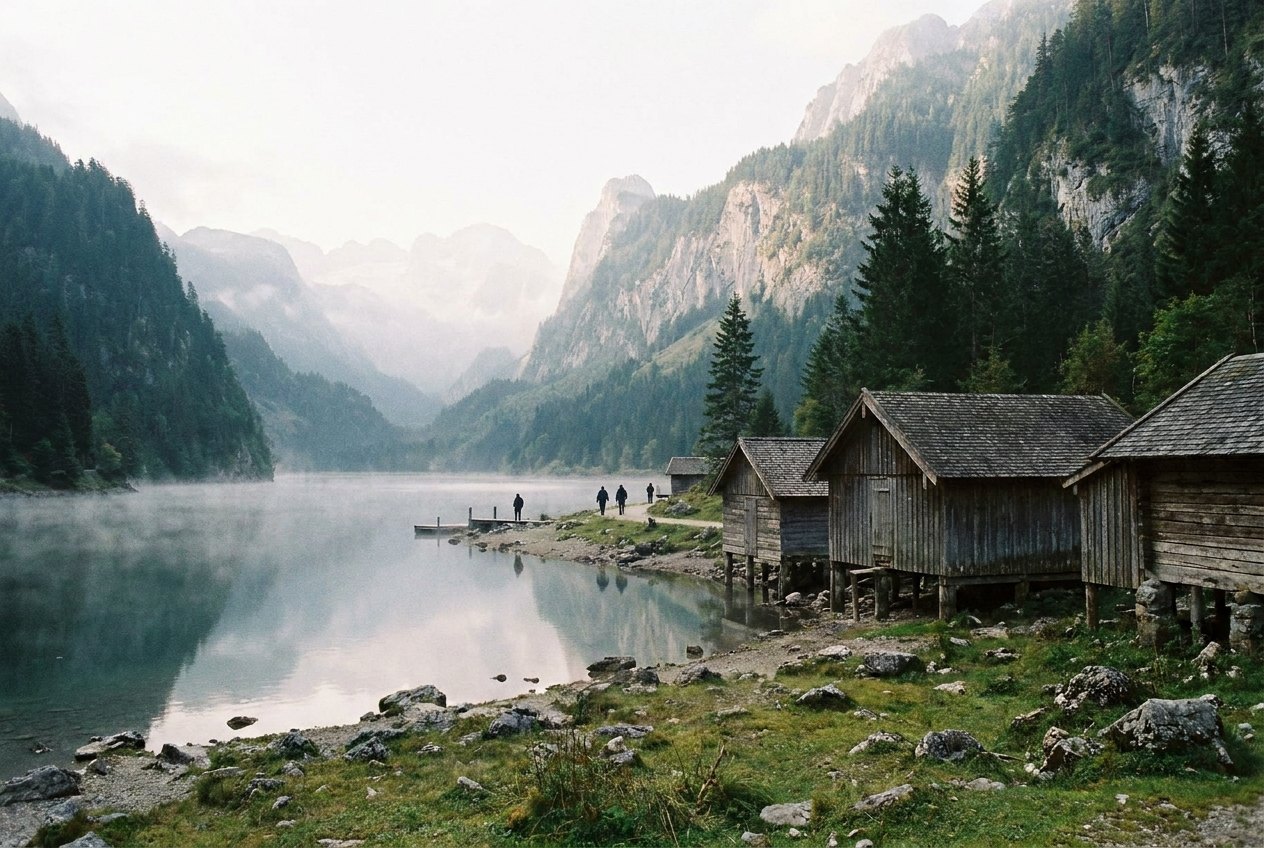
Before nine in the morning and after about five in the evening, the mood is very different. The lake is often still, the mist lifts off the water, and the bells carry across from the church. You hear boats, birds and the odd door opening. If you can, stay the night in the village or nearby, so you are already there when the quiet hours begin. It is one of the clearest cases for travelling in spring or autumn, when even the busy hours are gentler.
Remember that Hallstatt is a home, not a stage. Stay out of private gardens and off private jetties, keep drones grounded, and step aside for residents getting on with their day.
Walking by the lake
The main street runs along the shore past the small market square, with its fountain and painted houses. Keep walking and lanes branch off up the hill, with steps to the church and the higher houses. At the northern end of the village, a short walk past the last houses brings you to the viewpoint for the classic view back across the rooftops to the church spire. Go early and you may have it to yourself.
A path also follows the lakeshore beyond the village in both directions, with benches, small beaches and quiet spots for a picnic. In the south, it continues towards Lahn, the southern part of the village, and onwards along the water. The path is mostly level, and on a calm morning the reflections on the lake are the best part of a visit. For a similar approach to another busy place, read about the Cinque Terre.
Arriving by train and ferry
The nicest way to arrive is by train. Hallstatt has a small station on the Salzkammergut railway line, the line that runs through Bad Ischl, but the station is on the opposite shore of the lake. From the platform, a short path leads down to a landing, and a small passenger ferry crosses to the village in a few minutes. Boats are timed to meet the trains, but not every train has a ferry, especially in the quieter months.
The crossing itself is the arrival every visitor should have: the village slowly growing larger across the water, the church spire and the houses rising up the slope. Travel light, since the village streets are narrow and stepped, and there is no taxi waiting at the landing. Our guide to European train travel covers the habits that make a change of trains easy.
Filed under towns worth slowing for.