
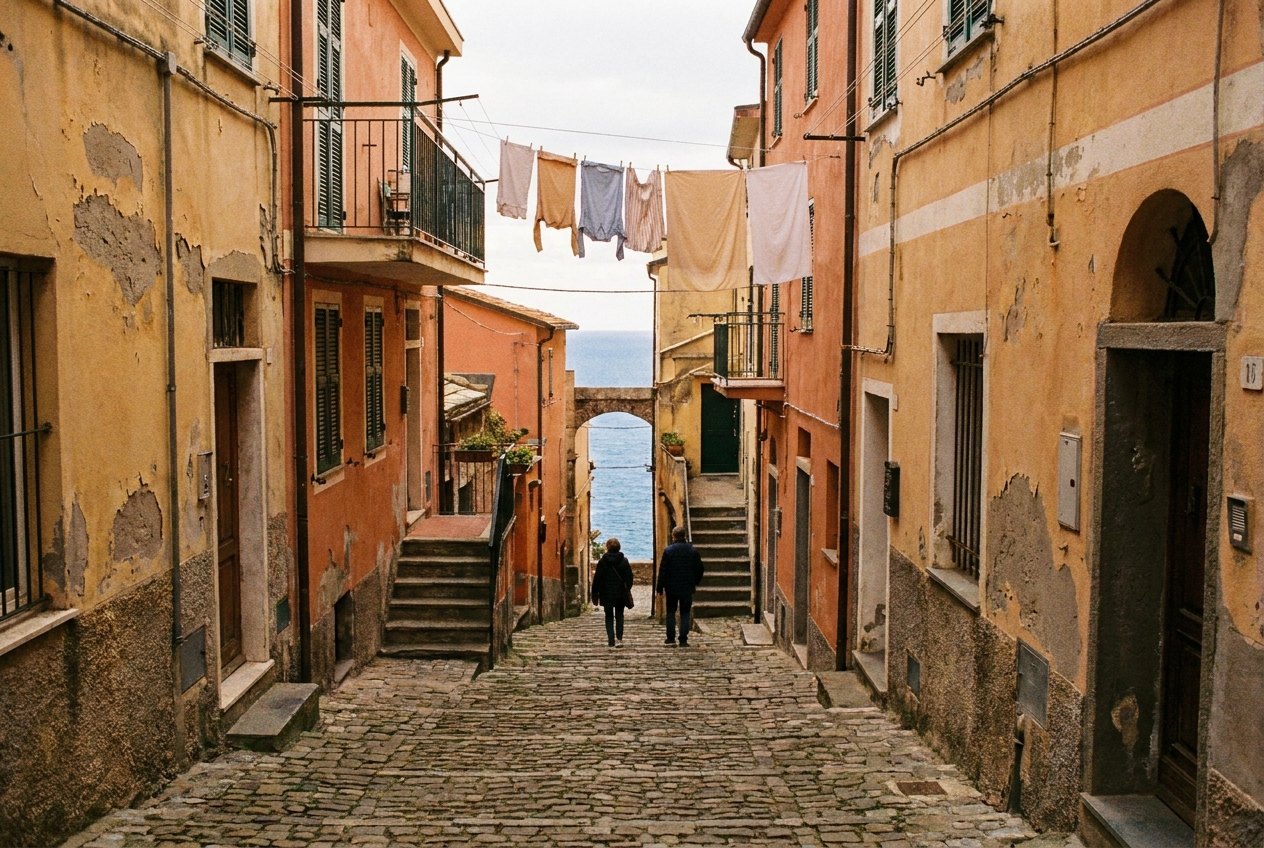
Worth knowingCorniglia's station sits well below the village; a long brick stairway climbs up, and a small shuttle bus also runs, so arriving with a heavy bag is a real effort.
Five villages on one steep shore
The Cinque Terre is a short run of coast in Liguria, between Levanto and La Spezia, where five old fishing and farming villages hold on to the cliffs. From north to south they are Monterosso al Mare, Vernazza, Corniglia, Manarola and Riomaggiore. The hillsides around them are cut into narrow terraces held up by dry-stone walls, built over centuries for vines and olives. The whole area, sea included, is a national park and a protected landscape.
Each village has its own feel. Monterosso is the largest, with the longest sandy beach and a flatter old town. Vernazza crowds around a small harbour watched over by a stone tower. Corniglia is the odd one out, perched high on a headland with no harbour at all. Manarola stacks its houses above a rocky inlet, and Riomaggiore runs down a steep ravine to a tiny landing.
Riding the train between them
The railway is the backbone of the place. Regional trains on the line between La Spezia and Levanto stop at all five villages, and the hops between them are only a few minutes long, much of it in tunnels. Trains run often, though at busy times they fill up quickly, and the platforms in some villages are short and partly inside the tunnel.
Your ticket choices change from time to time. There are ordinary single tickets, and there is a park card that includes unlimited use of these regional trains in the area along with access to the paid coastal paths. The prices and the options vary by season. If you use paper tickets, remember to validate them before boarding, a habit covered in our piece on travelling Europe by train.
In the warmer months, boats also link several of the villages and give the best view of them from the water. They do not call at Corniglia, which has no harbour, and they stop in rough seas.
The coastal paths and their closures
The best-known route is the Sentiero Azzurro, the blue path, which links the five villages along the coast. It is not one easy promenade. Stretches between Monterosso, Vernazza and Corniglia climb and drop on narrow, rocky trails with many steps and long drops on the seaward side. The short stretch between Riomaggiore and Manarola, the Via dell'Amore, is a much gentler walk along the cliff and has spent long periods closed for rockfall repairs.
Landslides after heavy rain are a fact of life here, and parts of the path close for repairs or after storms, sometimes for months or years. Before you plan a walk, check which sections are open on the park's information. Some sections need a paid park card or trail ticket, and rangers check at entry points.
 Pairs well withLauterbrunnen and the car-free villages above it
When the coastal path is busy or closed, the higher trails are a quieter alternative. Paths climb through terraces and woods to old sanctuaries above the villages, and on a clear day the view runs down the whole coast. They are steeper and longer, and you need proper shoes, water and a bit of experience on mountain paths. The higher trails are also where you see the terraces and their walls up close.
Why spring and autumn work best
In summer the Cinque Terre struggles under its own popularity. The narrow streets of Vernazza and Manarola fill from mid-morning, trains are packed, and the coastal paths can turn into a slow queue. Many visitors arrive on day trips, including passengers from cruise ships calling at La Spezia and other ports nearby, which concentrates crowds into the middle of the day.
In April, May, late September and October, the light is softer, the paths are cooler to walk and there is more space everywhere. The sea can still be warm enough for a swim in early autumn. The grape harvest on the terraces usually falls around September, depending on the year. The trade-off is weather: spring can be showery, and autumn storms can close paths for a day or longer. Leaving a spare day in your plans helps a lot. Our piece on the shoulder seasons covers the wider pattern.
In winter many of the villages grow very quiet. Some places close for a while, and boats stop running, but the trains keep going and the paths that are open are almost empty.
How to spend the quiet hours
The day-trippers' rhythm is easy to sidestep. Walk early in the morning, when the path is cool and you share it with a handful of others. Spend the middle of the day in the village you are staying in, or out on the hill paths, and return to the harbours in the late afternoon when trains carry most of the visitors away.
Sleeping in one of the villages, or in Levanto or La Spezia at either end of the line, means you see the coast at both ends of the day. Evening is when the places feel most like themselves: someone hauling a boat out of the water in Vernazza, children kicking a ball in a piazza, the last light on the coloured houses of Manarola. Pack light, since many rooms are up steep stairs, and keep simple picnics in mind: a bit of focaccia and fruit eaten on a harbour wall suits this coast perfectly.
Filed under towns worth slowing for.