
Worth knowingThe walk from Bruges station to the Markt takes about twenty minutes over cobbles; local buses also run into the centre from the stop outside the station.
Why Bruges is worth a night
Bruges was one of the richest trading cities in northern Europe in the Middle Ages. When its access to the sea silted up and trade moved elsewhere, the city slowly lost its importance, and much of its old centre survived largely as it was. Today the historic centre, ringed by canals, is a UNESCO World Heritage site, and it draws visitors from all over the world.
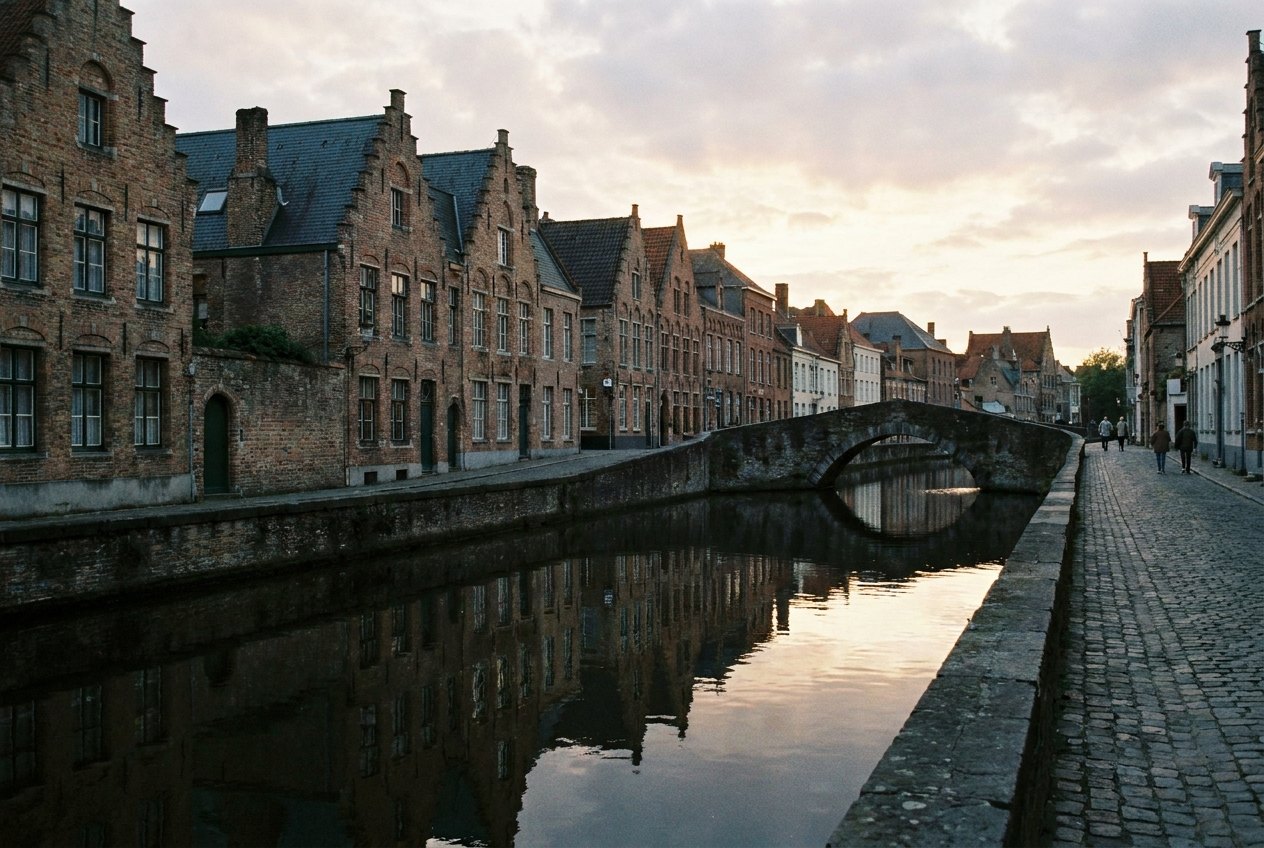
Many of them come for the day, often from Brussels, Ghent or a cruise ship berthed at the coast. They arrive mid-morning and leave by late afternoon. If you stay the night, you see a different place: a small, lived-in city where people cycle home from work, the canals go still, and the brick gables glow under the street lamps.
The Markt and the Burg
Two squares sit at the centre of the old town, a short walk apart. The Markt is the larger one, lined with tall, step-gabled houses and overlooked by the Belfry, the medieval bell tower that has become the symbol of the city. You can climb the tower by a long, narrow stairway, and the view over the roofs is worth the effort. Visitor numbers on the stairs are limited, so expect a wait at busy times.
A short lane leads from the Markt to the Burg, a smaller, more formal square. Here stand the Gothic town hall, the Stadhuis, with its elaborate stone front, and the Basilica of the Holy Blood, a double chapel with a darker Romanesque lower church and a richly decorated upper one. Late in the day, after the crowds thin out, the Burg is one of the calmest corners of the city.
From the Burg, a narrow passage leads to the canal side, and a few steps further on is the Rozenhoedkaai, the quay where the canal bends beneath a row of old houses with the Belfry rising behind. It is the classic view of Bruges, and in the evening, with the lamps reflected in the water, it is easy to see why.
Canals in the morning and evening
Daytime in Bruges belongs to the canal boats, the horse-drawn carriages and the groups following a guide's umbrella. Early morning and evening belong to everyone else. Walk the quays between the Markt and the Groeninge Museum before nine in the morning and you will meet more joggers than tourists. Swans drift on the water, the boats are tied up, and the bridges are empty.
 Pairs well withThe Dingle Peninsula loop, taken slowly
In the evening, after the shops close, the city goes quiet. Wander without a plan along the smaller canals in the east of the centre, around the Langerei and Sint-Annarei, where the streets are mostly residential. The houses are lit from inside, the water is dark and still, and the only sound may be a bicycle bell. For more ideas on enjoying busy places in quiet hours, read about Hallstatt early and late.
The Begijnhof and the quiet south
The Begijnhof, south of the centre, is one of the most peaceful places in the city. It was founded in the Middle Ages as a home for beguines, women who lived a religious life without taking full vows. Today the white-painted houses around a lawn of tall trees are home to a community of Benedictine nuns and other residents. Visitors are asked to keep quiet, and the gate closes in the evening. Come in spring and the lawn may be covered with daffodils.
Just beyond it lies the Minnewater, a canal lake with a park along its banks, often called the Lake of Love. In the mornings it is a place of swans and joggers rather than tour groups. The Church of Our Lady is nearby too, its tall brick tower one of the highest in the city, and inside is a marble Madonna and Child by Michelangelo. The city's big museums are near here as well, and much the same advice holds as for museums anywhere: go early, go late, choose a few rooms.
Windmills on the old ramparts
The city's medieval walls have mostly gone, but the line of the ramparts on the eastern side is now a long green park along the outer canal, the Kruisvest. Several windmills stand along it, on grassy mounds above the water. A few are original to Bruges, others were brought here from elsewhere in Flanders. At least one is open to visitors in the warmer months, and you can see the millstones at work when the wind is right.
A walk along the ramparts, from the Kruispoort gate north past the windmills and back into the centre through the quiet streets around Sint-Anna, makes a lovely end to the day. It is also a fine route for a bicycle.
By train and by bike
Bruges is easy to reach by train. Direct trains run from Brussels, with stops including Ghent, and the journey takes about an hour. The station is on the southern edge of the old town. From there you can walk into the centre or take a local bus.
Cycling is part of daily life in Flanders, and Bruges is flat, compact and well set up for bikes. Bike rental is easy to find near the station and in town. In many one-way streets in the centre, bicycles are allowed to ride in both directions, so watch for signs. Cobbles make for a bumpy ride, and pedestrians step out without looking, so ride slowly in the centre. For travelling in Europe by rail more widely, read about Europe by train.
Filed under towns worth slowing for.