
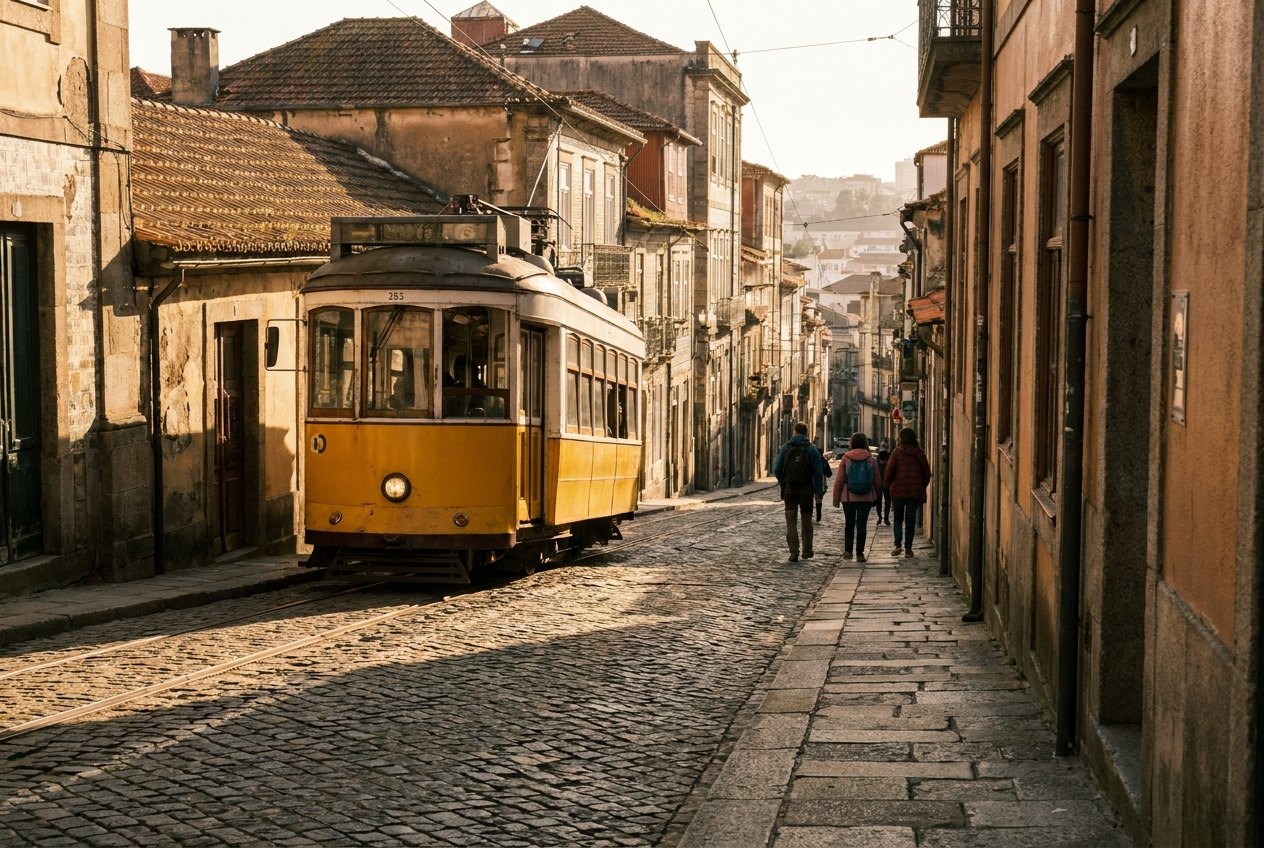
Worth knowingThe patterned limestone pavements turn slick after rain and even when dry on steep slopes; walk the hills slowly in shoes with rubber soles.
A city built on hills
Lisbon spreads over a series of steep hills on the north bank of the Tagus, where the river widens into a broad estuary before meeting the Atlantic. The old neighbourhoods tumble down the slopes to the water, with stairways, lanes and lookout points squeezed between them. Walking here is never flat for long, but it is endlessly rewarding: every corner seems to open onto a new view of roofs, river and sky.
The trick to enjoying the city on foot is to work with the hills, not against them. Walk the flat downtown streets, take the slopes downhill when you can, and save your legs on the climbs by riding the old trams and funiculars. The city's metro and buses fill in the gaps.
Baixa, the flat heart
The Baixa, or downtown, sits in the valley between the hills. It was rebuilt after the great earthquake of 1755, which destroyed much of the city, and its straight streets on a grid are a contrast to the tangle of lanes on the hills. At its southern end, the vast Praça do Comércio opens onto the river, entered from the north through a triumphal arch on Rua Augusta, the main pedestrian street.
This is the easiest part of Lisbon to walk, and a good starting point for every day. From here, Alfama climbs to the east, and Chiado and Bairro Alto rise to the west. Look down as you walk: the pavements are made of small limestone and basalt cubes laid in patterns, a craft known as calçada portuguesa, and some squares are covered in wave designs.
Lovely as they are, those polished stones are also slippery, especially on slopes and after rain. Shoes with rubber soles and good grip make a real difference here, a point that comes up again in packing one bag for two weeks.
Alfama and the castle hill
Alfama is the oldest district, a maze of narrow lanes, stairways and small squares on the slope below the Castelo de São Jorge. It survived the 1755 earthquake better than the lower town, and its street plan is much older than the Baixa's. Washing hangs from windows, tiled facades catch the light, and neighbours talk across the lanes. In the evenings, small places in the district play fado, the city's melancholy song.
Getting lost in Alfama is half the point, but the hill is steep. A good plan is to ride up to the top, near the castle or the viewpoints, and then walk downhill through the lanes towards the river. On the way you pass the Sé, the city's cathedral, a sturdy Romanesque building with fortress-like towers.
A good plan is to ride up to the top, near the castle or the viewpoints, and then walk downhill through the lanes towards the river.
The old trams and the funiculars
Lisbon's old yellow trams are one of the great pleasures of the city. Small, wooden-bodied and rattling, they grind up slopes and around corners that seem impossible for a tram. The best known is line 28, which runs from Martim Moniz through Graça, past Alfama and the cathedral, through the Baixa and Chiado and on towards Estrela and Campo de Ourique. It is a ride through much of old Lisbon.
It is also very popular, and at busy times there is a long queue at the terminus and standing room only on board. Riding early in the morning or in the evening is far easier. Line 28 is notorious for pickpockets, who work the crowded cars and the doorways, so keep bags zipped and in front of you, and keep phones and wallets out of back pockets. Our piece on pickpockets and peace of mind covers the habits that help.
 Pairs well withWhy spring and autumn suit Europe best
The city also has several funiculars, called elevadores, that climb some of the steepest streets, and a street lift, the Elevador de Santa Justa, that links the Baixa with the higher ground of the Carmo area. After a fatal accident on one of the funiculars in 2025, services have been reviewed.
Bairro Alto, Chiado and the viewpoints
West of the Baixa, Chiado is an elegant district of shops, cafés and theatres, and above it, Bairro Alto is a grid of narrow streets that is quiet by day and very lively late at night. Between them, you can see the ruins of the Carmo Convent, its roofless Gothic arches left open to the sky since the earthquake.
Lisbon's lookout points, the miradouros, are its great free pleasure. Several are worth seeking out:
- Miradouro de Santa Luzia and the nearby Portas do Sol, over the rooftops of Alfama to the river
- Miradouro da Graça, with a wide view west to the castle and the centre
- Miradouro da Senhora do Monte, one of the highest, with a panorama over much of the city
- Miradouro de São Pedro de Alcântara, in Bairro Alto, looking east to the castle hill
Sunset is the classic time, when the light turns the roofs gold and the river silver. The viewpoints fill up then, so arrive a little early and find a place along the wall. As always in crowds, keep an eye on your bag.
Out to Belém
West along the river, Belém is where many of Portugal's sea voyages began, and its monuments celebrate that age. The Jerónimos Monastery is a masterpiece of the ornate Manueline style, with a richly carved cloister. Nearby, by the river, stands the Belém Tower, a small fortress on the water, and the Padrão dos Descobrimentos, a large modern monument to the explorers. The famous custard tarts, pastéis de nata, are sold all over the city and are especially associated with Belém.
You can reach Belém by tram line 15 from the area of Praça da Figueira and Praça do Comércio, or by suburban train from Cais do Sodré station on the line towards Cascais. The train is quick, and the tram is scenic. The monastery and tower draw long queues at busy times, so arrive early, much as you would for the big museums. Afterwards, walk along the riverside promenade, where the breeze off the water is welcome after a day on the hills, and plan to linger over a long lunch before heading back.
Filed under towns worth slowing for.